
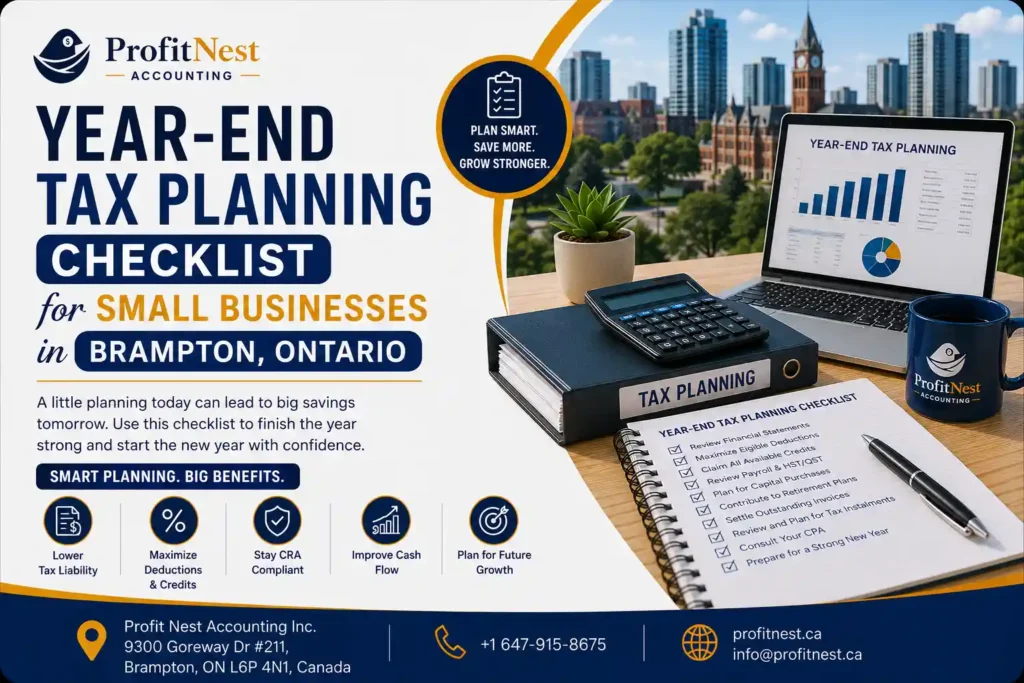
Every November, the same question lands in accountants’ inboxes across Brampton: “Can you just send me your year-end tax checklist so I know what documents to file?”
Here’s the confusion — tax planning and tax filing are two completely different things, and mixing them up is the single biggest reason small business owners in Brampton, Mississauga, and across the GTA overpay the CRA every year.
Filing is what happens after the year is already closed — you’re reporting what happened. Planning happens before December 31, while you can still change the outcome: shifting income, timing expenses, maximizing deductions, and structuring things so your final tax bill is legitimately lower.
This guide breaks down a real, actionable year-end tax planning checklist for small businesses, clears up exactly where planning ends and filing begins, and helps you figure out which service actually fits your situation — whether you’re self-employed, incorporated, or managing high-net-worth income.
Year-End Tax Planning vs. Year-End Tax Filing: The Quick Comparison
Year-End Tax Planning | Year-End Tax Filing | |
When it happens | Before Dec 31 (proactive) | After year-end / by the CRA deadline (reactive) |
Goal | Reduce what you owe legally | Report what already happened |
What it involves | Income timing, expense timing, RRSP/dividend strategy, capital purchases, bonus vs. dividend decisions | T2 corporate returns, T1 personal returns, GST/HST reconciliation |
Who benefits most | Incorporated businesses, self-employed owners, high-net-worth individuals | Every taxpayer, every year |
Can it lower your tax bill? | Yes — this is where the savings happen | No — the numbers are already locked in |
Best time to start | October–November | Once your fiscal/calendar year has closed |
If tax planning is where your numbers actually shrink, filing is simply where they get reported correctly — which is why a year-end tax planning checklist in Brampton should never be confused with a plain document-collection list. Once your planning decisions are made, filing itself — including corporate tax filing — becomes far more straightforward.
The Actual Year-End Tax Planning Checklist
1. Review Your Income and Expense Timing
Before December 31, look at whether pulling forward an expense (or deferring invoicing income into the new year) genuinely helps your tax position. Small shifts here can move you into a lower bracket or defer tax by a full year.
2. Decide: Salary or Dividends (If You're Incorporated)
This single decision affects your personal tax, corporate tax, CPP contributions, and RRSP room. There’s no universal “better” answer — it depends on your cash flow needs and long-term retirement planning.
3. Maximize Legitimate Business Deductions
Vehicle expenses, home office costs, professional fees, and equipment purchases all need to be captured and documented properly before year-end — not reconstructed from memory in April.
4. Check Your GST/HST Position
If your revenue has crossed $30,000 in the last four consecutive quarters, registration isn’t optional. Reviewing your GST/HST filing status now avoids penalties later. Full details on GST/HST filing requirements are worth a look if you’re unsure where you stand.
5. Review Capital Purchases and Asset Write-Offs
Planning equipment or asset purchases before your fiscal year-end (rather than in January) can accelerate deductions through capital cost allowance.
6. Reconcile Your Books — Don't Wait for Filing Season
Messy books are the #1 reason planning conversations go nowhere. If your bookkeeping isn’t current, no amount of tax strategy can be built on top of it.
7. Plan Around Payroll and T4/T4A Obligations
If you have employees or contractors, year-end is when bonus timing, T4 preparation, and remittance schedules need to be locked in. This ties directly into your payroll services planning.
8. Revisit Your Corporate Structure
If your business has grown significantly this year, it may be time to reassess whether your current setup — sole proprietorship, incorporation, or holding company — still makes sense. This is where startup and incorporation support or company registration guidance becomes relevant.
Which Situation Are You In? Mapping Your Checklist to the Right Service
Not every business owner needs the same checklist. Here’s how it typically breaks down:
If you’re self-employed or a sole proprietor — your focus is expense tracking, mileage logs, and home office deductions. You’ll want solid personal tax filing support that understands self-employment and rideshare/contractor income specifically.
If you’re incorporated — salary vs. dividend decisions, capital purchases, and corporate deductions matter far more, and they need to be planned before your fiscal year closes, not after. This is squarely corporate tax filing and planning territory.
If you’re high-net-worth or have multiple income streams — investment income, rental properties, and multiple corporate entities need coordinated planning across both personal and corporate returns, ideally with someone reviewing your bookkeeping and filings together rather than in silos.
This is exactly why a combined approach — bookkeeping, corporate tax, personal tax, and payroll under one roof — tends to catch savings that get missed when these pieces are handled by separate people who never talk to each other. ProfitNest, based in Brampton and serving Mississauga, Toronto, Hamilton, and Ottawa, works this way deliberately: your books, your corporate filing, and your personal return are reviewed together, so planning decisions made in November actually show up correctly in your return come spring.
Curious how the team works or want to see their full track record? Their About page and team page walk through their approach and experience in more detail. There’s also a running blog with more Brampton-specific tax breakdowns if you want to go deeper on a particular topic.
FAQs: Year-End Tax Planning for Small Businesses
1. What's the actual difference between tax planning and tax filing?
2. When should small businesses start year-end tax planning?
3. Do sole proprietors need year-end tax planning, or is that just for incorporated businesses?
4. What documents should I have ready for year-end planning?
5. Can year-end tax planning actually lower my GST/HST liability?
6. Is it too late to do tax planning if my fiscal year already ended?
Conclusion
A real year-end tax planning checklist isn’t a document-collection list for your accountant — it’s a set of decisions you still have time to make before your numbers are locked in. Whether you’re self-employed, incorporated, or juggling multiple income sources, the businesses that save the most are the ones that start this conversation in October or November, not April.
If you want a Brampton-based team to walk through your specific situation and map out what actually applies to you, talk to a ProfitNest Tax Expert before your year closes — planning now is what makes filing painless later.