
If you’ve typed “tax consultant vs accountant Ontario” into Google, you’re probably not alone — and you’re probably not confused for no reason. The titles get thrown around interchangeably by everyone from your cousin who “does taxes on the side” to big-box tax prep chains, and the lines really do blur in everyday use. But when it’s your money, your business, or a CRA letter sitting in your inbox, the difference matters more than it seems.
This guide breaks down what a tax consultant actually does, what an accountant actually does, and — more importantly — which one fits your situation: self-employed, incorporated, or managing more complex, high-net-worth finances.
The Short Answer
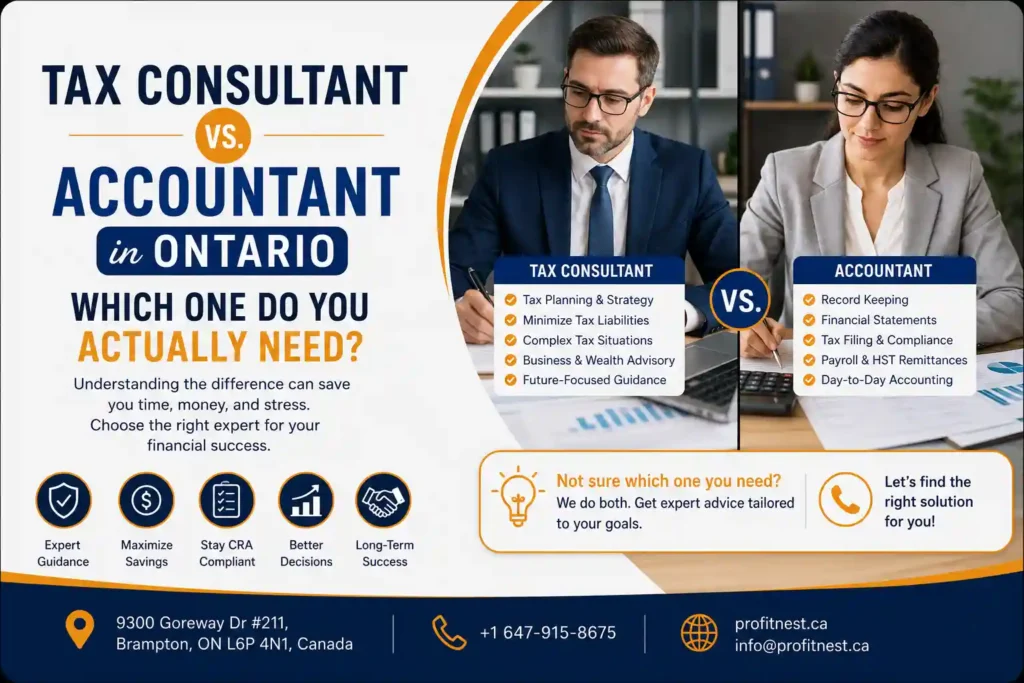
A tax consultant (sometimes called a tax advisor or tax planning consultant) focuses specifically on tax strategy — minimizing what you owe, planning ahead, and advising on tax-efficient decisions. An accountant takes a broader view: bookkeeping, financial statements, payroll, and yes, tax filing too, but as part of the full financial picture.
In practice, most Ontario individuals and small businesses don’t need to choose one over the other — they need both, working together. That’s exactly why firms offering combined accounting and tax services have become the practical default for busy business owners.
This guide breaks down what a tax consultant actually does, what an accountant actually does, and — more importantly — which one fits your situation: self-employed, incorporated, or managing more complex, high-net-worth finances.
Tax Consultant vs. Accountant: Side-by-Side Comparison
Tax Consultant | Accountant | |
Primary focus | Tax strategy, planning, and advisory | Full financial management (bookkeeping, statements, tax) |
Best for | Reducing tax liability, complex tax situations, CRA disputes | Ongoing financial records, compliance, year-round support |
Typical services | Tax planning, tax return consulting, GST/HST advisory, tax resolution | Bookkeeping, corporate tax filing, payroll, financial reporting |
When you need them | Before a big financial decision, during tax season, when facing a CRA issue | Year-round, especially if incorporated or self-employed |
Credentials to look for | CPA, tax law background, or specialized tax certification | CPA (Chartered Professional Accountant) |
Relationship type | Often project-based or seasonal | Usually ongoing and relationship-based |
Want the specifics on how corporate filing works with a combined tax and accounting approach? See our Corporate Tax Filing services.
So Which One Do You Need? Match Your Situation
If You're Self-Employed or a Sole Proprietor
You’re likely juggling irregular income, business expenses, mileage logs, and maybe HST remittances — all while trying to run the actual business. What you need most is someone who can keep clean books and file your personal tax return correctly, catching every deduction you’re entitled to. This is squarely accountant territory, though a tax-planning conversation once a year (structuring, RRSP contributions, HST thresholds) adds real value too.
If You're Incorporated
Once you’ve incorporated, the stakes go up. You’re now dealing with T2 corporate returns, corporate tax filing obligations, payroll if you have employees, and ongoing bookkeeping that has to stay CRA-compliant year-round. This is where an accountant becomes essential — but a tax consultant’s strategic input (salary vs. dividends, income splitting, corporate structuring) can meaningfully lower what your business owes. Ideally, this isn’t two separate people — it’s one team that talks to each other, which is exactly the gap firms like ProfitNest are built to close for Ontario businesses going through startup and incorporation support.
If You Have Complex or High-Net-Worth Finances
Multiple income streams, rental properties, investments, cross-border considerations, or a business you’re planning to sell — this is where a tax consultant’s planning skills matter most. You need someone thinking several years ahead, not just filing what happened last year. That said, none of that planning works without airtight books and accurate historical filings behind it, which is where the accounting side still carries the load.
Why Most Ontario Businesses End Up Wanting Both
Here’s the practical reality: a tax consultant without accounting support is planning on incomplete numbers. An accountant without tax strategy is filing accurately but leaving savings on the table. The two roles are genuinely complementary, not competing — which is why so many Ontario business owners eventually consolidate to one firm that offers both under one roof.
That’s the model ProfitNest runs on. Based in Brampton and serving individuals and businesses across Toronto, Mississauga, Hamilton, and Ottawa, the team handles personal tax filing, corporate tax filing, bookkeeping, payroll, and GST/HST compliance — so you’re not stuck coordinating between a separate consultant and accountant who’ve never spoken to each other. One team sees your full financial picture and files accordingly.
Frequently Asked Questions
Is a tax consultant the same as an accountant?
Do I need an accountant if I'm self-employed in Ontario?
Can a tax consultant help if I owe back taxes to the CRA?
Is it worth paying for both a tax consultant and an accountant?
How much does a tax consultant cost in Ontario?
What should I look for when choosing between the two?
Conclusion
“Tax consultant vs. accountant” isn’t really an either/or question for most Ontario individuals and businesses — it’s a question of what stage you’re at and what you need right now. Self-employed and just need clean, accurate filing? Lean accountant. Facing a big strategic decision or a CRA issue? Lean consultant. Incorporated or growing? You’ll likely want both, ideally from a team that already works together.
That’s the simplest way to stop overthinking the title on the door and start focusing on what actually matters — accurate filings, smart planning, and one less thing to worry about at tax time.