
“I already have someone who does my books — why would I need a CPA?” It’s one of the most common questions Ontario business owners ask, usually right before a bank, a lawyer, or the CRA tells them their current setup isn’t enough. Bookkeepers and unlicensed tax preparers are genuinely useful for day-to-day records. But there are specific moments where the law — or the institution you’re dealing with — requires a licensed CPA, full stop. No workaround, no substitute.
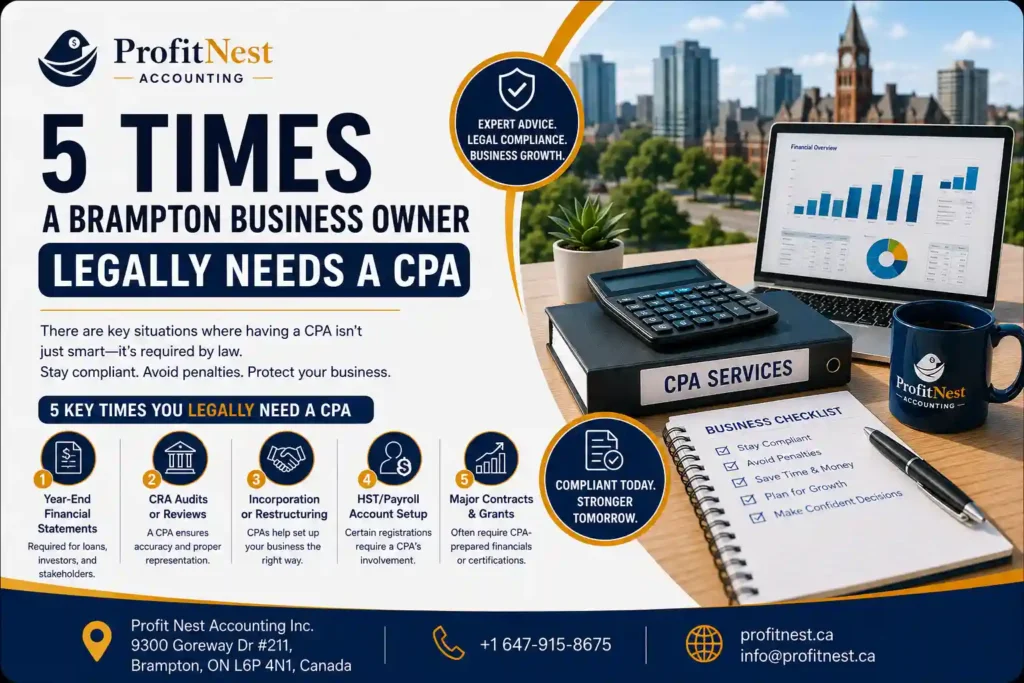
Running a business in Brampton, Ontario comes with more financial complexity than most owners expect — from CRA compliance to loan applications and business sales. While any accountant can help with day-to-day bookkeeping, certain situations legally require the expertise of a licensed CPA in Brampton Ontario. Hiring the wrong professional for these moments doesn’t just cost you money — it can put your business at risk. Here are five situations where only a CPA will do.
Here are the five situations where that line gets drawn, and what to do about it.
What Is a CPA, Exactly?



A CPA (Chartered Professional Accountant) is a licensed, regulated professional under CPA Ontario, legally authorized to prepare notarized financial statements and represent clients before the CRA — unlike unlicensed bookkeepers or seasonal tax preparers. That regulatory backing is exactly why certain financial documents and formal representations must come from a CPA rather than anyone who simply “does accounting.”
Accountant vs. CPA in Brampton, Ontario: Quick Comparison
| General Accountant / Bookkeeper | CPA (Chartered Professional Accountant) | |
|---|---|---|
| Regulated by | No licensing body required | CPA Ontario |
| Can prepare notarized financial statements | No | Yes |
| Can represent you before the CRA | No | Yes |
| Legal/fiduciary responsibility | Limited | Formal fiduciary and professional standards |
| Accepted by banks & lawyers for loans, sales, audits | Often not sufficient | Yes |
| Best for | Day-to-day bookkeeping, simple filings | Corporate structuring, audits, loans, sales, investor due diligence |
For the situations below, this distinction stops being a technicality and starts being a requirement. See how it plays out in practice on our Corporate Tax Filing page.
The 5 Times You Legally Need a CPA
1. Incorporating Your Business
The moment you incorporate, CRA registration and your corporate structuring documents typically call for CPA-prepared financials — not a self-prepared spreadsheet. Getting this right from day one avoids a messy, expensive cleanup later when you try to file your first T2.
Practical tip: Line up your CPA before incorporation day, not after — the opening structure (shareholder setup, salary vs. dividend planning) is far easier to build correctly than to fix.
Related: Startup & Incorporation Support and Company Registration.
2. Applying for a Business Loan or Mortgage
Banks and lenders don’t accept just any financial statements — they require CPA-notarized or attested statements, not documents you or your bookkeeper drew up internally. Self-prepared numbers, however accurate, usually won’t clear underwriting.
Practical tip: Request your CPA-prepared statements weeks before you apply. Lenders often want the most recent fiscal year-end plus current interim figures, and rushing this stage is a common reason approvals stall.
Related: Bookkeeping Services — clean, ongoing books make CPA-attested statements faster and cheaper to produce.
3. Facing a CRA Audit or Review
Only a CPA can formally represent you before the CRA. If you’ve received an audit notice or a review letter, an unlicensed preparer can help you gather paperwork, but they cannot legally act as your representative in dealings with the CRA.
Practical tip: Don’t respond to a CRA audit letter on your own or wait to see if it “goes away.” Early, professional representation almost always leads to a smoother outcome than scrambling after a deadline passes.
Facing a CRA audit? Don’t wait — talk to a Profitnest CPA today.
4. Selling or Valuing Your Business
Buyers and their lawyers require CPA-certified statements for due diligence before a sale closes. A business valuation built on unverified numbers won’t hold up to scrutiny, and it can stall or even kill a deal at the negotiation table.
Practical tip: Start the CPA-certification process months before you plan to list your business for sale — due diligence moves faster (and buyers negotiate harder) when your financials are already clean and verifiable.
Related: Corporate Tax Filing for multi-year filing history that supports a credible valuation.
5. Bringing on Investors or Partners
Investors want CPA-reviewed financials before committing capital. Whether it’s a formal review engagement or a notice to reader with CPA sign-off, serious investors treat this as table stakes before writing a cheque.
Practical tip: Ask early what level of assurance your investor expects — a notice to reader and a full review engagement are very different in scope and cost, and knowing which one you need avoids paying for more (or less) than necessary.
Related: Financial Reporting statements that give partners and investors a clear, credible picture of the business.
Why Brampton Businesses Choose a CPA-Backed Team
Here’s the pattern across all five situations: the moment your business touches a bank, the CRA, a buyer, or an investor, self-prepared or bookkeeper-only records aren’t enough. You need someone with the CPA Ontario designation behind the numbers.
ProfitNest combines licensed CPA oversight with day-to-day bookkeeping, corporate tax filing, payroll, and GST/HST compliance — so your books stay audit-ready and CPA-attested year-round, not scrambled together the week a bank or the CRA asks for them. Based in Brampton and serving Mississauga, Toronto, Hamilton, and Ottawa, the team is built for exactly these moments.
Not sure if your situation needs a CPA? Book a free 15-minute consultation with a licensed CPA in Brampton → — get a straight answer before you make a costly mistake.
Frequently Asked Questions
What's the difference between an accountant and a CPA?
Do I need a CPA to incorporate my business in Ontario?
Can a bookkeeper represent me in a CRA audit?
Why do banks ask for CPA-notarized financial statements instead of my own?
When should I bring in a CPA if I'm selling my business?
Is a "notice to reader" the same as a CPA review engagement?
Conclusion
Most day-to-day accounting doesn’t legally require a CPA — but the moment you incorporate, apply for financing, face a CRA audit, sell your business, or bring on investors, the rules change. These aren’t situations where “good enough” bookkeeping cuts it; they require a licensed professional whose numbers carry legal and regulatory weight. Knowing which of these five moments applies to you now — or is coming soon — is the difference between a smooth process and a costly scramble.
Profitnest — Licensed CPAs Serving Brampton, Mississauga & the GTA. Talk to a Profitnest Tax Expert →