
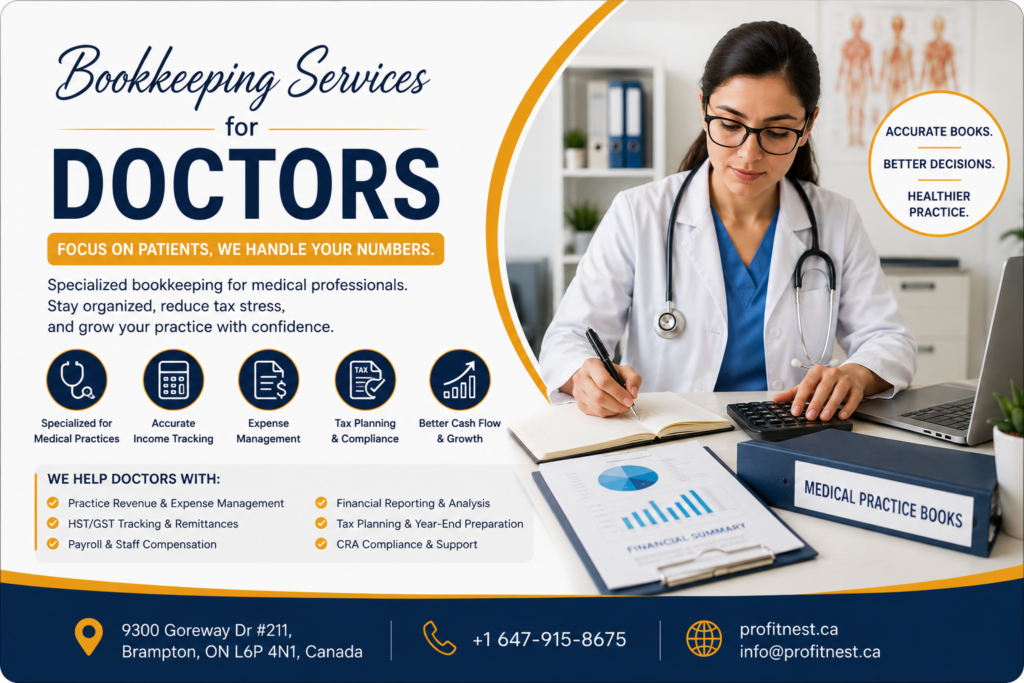
If you’re a doctor, you didn’t spend a decade in med school to spend your evenings reconciling bank statements. Yet that’s exactly where a lot of physicians, dentists, and specialists find themselves — buried in receipts, chasing HST filings, and wondering where last quarter’s profit actually went.
Here’s the honest answer to the question most doctors are quietly Googling: do doctors really need specialized bookkeeping services, or will any generic accountant do?
They need specialized help. A medical practice isn’t a regular small business — it has OHIP billing cycles, locum payments, equipment depreciation, associate splits, and CRA rules that a general bookkeeper simply isn’t trained to navigate. That’s precisely why bookkeeping services for doctors exist as a distinct niche, and why practices across Ontario are turning to firms like ProfitNest instead of a one-size-fits-all accountant.
This guide breaks down what proper doctors bookkeeping looks like, why it matters more than most physicians realize, and how to tell if your practice’s books are actually in good shape — or just look that way.
Why Regular Bookkeeping Doesn't Work for Medical Practices
Most generic bookkeeping templates are built for retail or service businesses. Doctors’ practices run on a completely different financial engine:
- Mixed income streams — OHIP billings, private-pay patients, insurance reimbursements, and cosmetic or elective procedures all need separate tracking.
- Professional corporation (PC) structures — many physicians operate through an MPC (Medical Professional Corporation), which changes how income, dividends, and taxes are recorded.
- Locum and associate arrangements — split billing and contractor payments need clean, audit-ready records.
- Equipment-heavy operations — dental chairs, imaging machines, and clinic renovations all involve capital cost allowance (CCA) calculations most bookkeepers rarely touch.
- Payroll for a clinical team — hygienists, RMTs, front-desk staff, and associate doctors often sit on different pay structures.
- CRA and provincial compliance — HST exemptions on medical services are nuanced, and getting them wrong invites red flags.
This is where the difference between “someone who does your books” and true bookkeeping services for doctors becomes obvious.
What Doctors Bookkeeping Actually Includes
A proper doctors bookkeeping system isn’t just data entry at year-end. It should be a running, month-over-month financial picture that tells you exactly how your practice is performing. At minimum, look for:
- Monthly reconciliation of clinic bank accounts and merchant/POS deposits
- Accounts payable tracking for suppliers, labs, and equipment vendors
- Payroll processing for clinical and administrative staff
- HST filing and remittance, correctly applied to exempt vs. taxable services
- Profit and loss statements broken down by service line (e.g., general visits vs. cosmetic procedures)
- Cash flow forecasting so you’re never blindsided by a slow month
- Year-end tax-ready financials handed straight to your accountant, with nothing to untangle
- Corporate structure support for MPCs, holding companies, and income-splitting strategies
When these run smoothly in the background, a physician gets something rare: a clear, honest number for what the practice actually earns — not a guess based on the bank balance.
Built for Every Kind of Practice, Not Just MDs
A common misconception is that “bookkeeping for doctors” only applies to family physicians or general practitioners. In reality, the same financial complexity applies across every regulated health practice, including:
- Family physicians & general practitioners
- Dentists & dental clinics
- Physiotherapists
- Chiropractors
- Optometrists
- Dermatologists & cosmetic clinics
- Naturopaths & wellness practitioners
- Psychologists & therapists in private practice
- Veterinarians (yes — same billing complexity, different patients)
- Medical specialists (cardiologists, radiologists, surgeons, etc.)
Whether it’s a solo chiropractic clinic in Brampton or a multi-associate dental practice in Mississauga, the underlying need is identical: books that reflect the real financial health of the practice, not just a pile of reconciled transactions.
DIY Bookkeeping vs. Professional Doctors Bookkeeping Services
| Factor | DIY / General Bookkeeper | Specialized Doctors Bookkeeping (ProfitNest) |
|---|---|---|
| Understanding of MPC/PC structures | Limited or none | Built-in expertise |
| HST handling for exempt medical services | Frequently misapplied | Correctly categorized |
| Time investment for the doctor | 5–10+ hours/month | Close to zero |
| Locum & associate payment tracking | Manual, error-prone | Streamlined, audit-ready |
| Year-end tax prep readiness | Often incomplete | Fully reconciled and ready |
| Cash flow visibility | Reactive (after the fact) | Proactive, monthly reporting |
| Risk of CRA red flags | Higher | Significantly reduced |
| Scalability as practice grows | Breaks down quickly | Built to scale with your clinic |
Why Doctors Across Ontario Choose ProfitNest
Not every bookkeeping firm understands the difference between a retail ledger and a medical practice’s books. ProfitNest was built around that gap — combining real bookkeeping expertise with a working understanding of how medical, dental, and allied health practices actually operate financially.
What that looks like in practice:
- Specialized knowledge of medical/dental corporate structures (MPCs, PCs, associate splits)
- Clean, monthly financials — not a year-end scramble
- HST and CRA compliance handled correctly, the first time
- Transparent pricing with no hidden year-end surprises
- A team that speaks both “clinical” and “financial” — so you’re never lost in jargon
- Cloud-based reporting, so you can check your numbers from your phone between patients
For a doctor, dentist, or clinic owner, that translates into one simple outcome: more time with patients, less time with spreadsheets.
Our Bookkeeping Service Areas
ProfitNest: Bookkeeping Services Across Ontario
ProfitNest proudly supports medical and healthcare practices throughout Ontario, with dedicated bookkeeping support in:
Not Just for Doctors — ProfitNest Serves Every Growing Business
While medical and dental practices are a core specialty, ProfitNest’s bookkeeping expertise extends well beyond healthcare. The same rigor applied to doctors’ books is applied across:

Retail & e-commerce businesses
Daily sales reconciliation, tip payroll, and tight-margin cost tracking, done right.

Real estate agents, brokerages & property investors
Commission tracking, closing costs, and rental income sorted out property by property.

Law firms & legal practices
Trust account compliance and client billing kept clean and audit-ready.

Trades & construction companies
Job-costing and progress billing that keeps every project's numbers separate and accurate.

Restaurants & food service businesses
Inventory-aware bookkeeping across in-store and online sales channels.

Professional service firms of all kinds
Recurring invoicing, retainers, and payroll are handled without the month-end scramble.
If your business has complex revenue streams, compliance requirements, or simply not enough hours in the day — ProfitNest’s bookkeeping team is built to handle it.
Frequently Asked Questions
Medical practices have unique income structures — OHIP billings, MPC/PC setups, locum splits, and HST exemptions — that a general bookkeeper often isn't trained to handle correctly. Specialized doctors bookkeeping reduces errors and keeps your practice CRA-compliant.
Pricing depends on practice size, transaction volume, and payroll complexity. Most firms, including ProfitNest, offer tiered monthly packages so solo practitioners and multi-associate clinics both pay for what they actually need — reach out for a tailored quote.
Yes — and this is one of the most common problem areas. Many medical services are HST-exempt, but cosmetic procedures, certain dental work, and retail add-ons may not be. Specialized doctors bookkeeping applies the correct treatment to each revenue line.
It covers the full range of regulated health practices — dentists, chiropractors, physiotherapists, optometrists, dermatologists, naturopaths, psychologists, and veterinarians all deal with similar billing and compliance complexity and all benefit from the same bookkeeping approach.
Bookkeeping covers the day-to-day: reconciliation, payroll, HST filing, and monthly reporting. Accounting builds on that with tax strategy, corporate structuring, and year-end filing. Clean bookkeeping makes accounting faster, cheaper, and more accurate — the two work best together.
Yes. Most doctors bookkeeping today is handled through cloud-based software, so practices anywhere in Ontario — not just Toronto, Ottawa, Mississauga, Brampton, or Hamilton — can access the same level of support without an in-person visit.
Monthly. Waiting until quarter-end or tax season is the single biggest reason practices lose track of cash flow and miss deductible expenses. Monthly reconciliation means you always know where the practice stands, and your year-end filing becomes a formality instead of a scramble.
Typically just bank and credit card statements, payroll records, OHIP/insurance remittance summaries, and prior-year financials if available. A proper onboarding process — like the one ProfitNest runs — should take this off your plate almost entirely rather than asking you to compile a full financial package yourself.
Need More Questions?
Ready to see what your practice’s books should actually look like? ProfitNest’s team can review your current setup and show you exactly where the gaps are — no obligation, just clarity.