
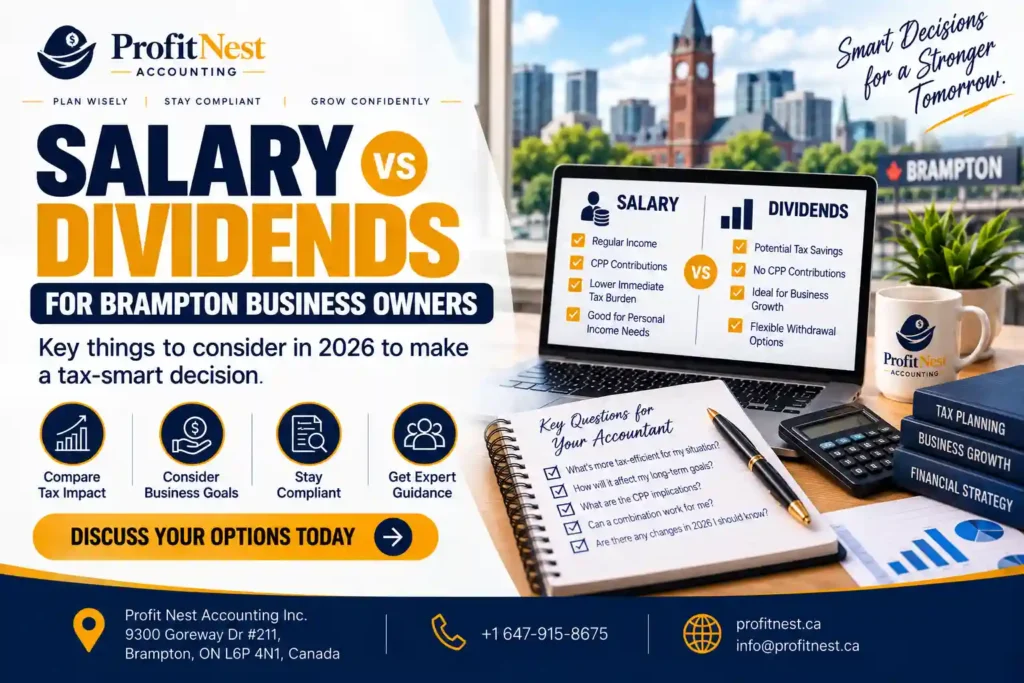
Should you pay yourself a salary or dividends from your corporation in Ontario? For Brampton business owners, this decision can affect personal income tax, corporate tax, Canada Pension Plan (CPP) contributions, RRSP contribution room, and the money available for business growth.
A salary is generally deductible for corporate tax purposes when the applicable requirements are met, while dividends are usually distributed from after-tax corporate profits. Salary can help build RRSP contribution room and CPP entitlements, whereas dividends provide another way to distribute available corporate profits.
The right choice depends on your corporation’s earnings, personal income requirements, retirement goals, and overall tax position. In this guide, ProfitNest explains the differences, examines a numerical tax illustration, and provides a practical checklist to help incorporated business owners make informed decisions in 2026.
What Is the Difference Between Salary and Dividends in Ontario?
Salary is compensation paid to you for working in your corporation. Dividends are distributions paid to shareholders from corporate profits or other amounts legally available for distribution.
The key distinction is how each payment is treated for corporate and personal tax purposes.
| Factor | Salary | Dividends |
|---|---|---|
| Corporate tax treatment | Generally deductible when eligible | Generally not deductible |
| Personal tax treatment | Employment income | Taxable dividends |
| CPP contributions | Generally applicable | Not applicable |
| RRSP contribution room | Eligible salary can generate room | Does not generate room |
| Payroll administration | Usually required | Dividend documentation and reporting required |
| Payment structure | Often regular paycheques | Can offer distribution flexibility |
| Corporate profits | Reduces taxable corporate income when deductible | Normally paid from after-tax corporate income |
The CRA’s personal income tax guidance explains the applicable 2026 federal and provincial tax brackets. Salary and dividends also have different deductions, credits, and contribution rules.
How Does Salary Work for an Incorporated Business Owner?
When your corporation pays you a salary, it generally records the payment as an employment expense. The corporation must normally calculate payroll deductions, remit the applicable amounts, and prepare the required year-end reporting.
Salary may be useful if you want predictable personal income and a structured approach to retirement savings.
Main benefits of salary
Regular income: A predictable paycheque can make household budgeting easier.
RRSP contribution room: Eligible earned income can generate RRSP contribution room under the applicable rules.
CPP participation: Salary generally creates CPP contributions and can build entitlement to CPP benefits.
Income documentation: T4 slips and pay statements can help document employment income when applying for financing.
Financial planning: Regular payroll can make personal budgeting and corporate cash-flow forecasting easier.
Salary also creates employer payroll costs, including the employer’s share of CPP where applicable. These costs should be included when comparing salary with dividends.
How Do Dividends Work in Ontario?
Dividends are generally paid to shareholders from corporate profits after applicable corporate taxes have been considered. The corporation does not normally deduct dividends as a business expense.
Canadian tax law distinguishes between eligible and non-eligible dividends. The classification affects the dividend gross-up and tax credit used to calculate personal tax.
Main benefits of dividends
No CPP contributions: Dividends are not subject to CPP contributions.
Distribution flexibility: Dividends may be useful when a corporation has sufficient profits and cash available for a lawful distribution.
Different personal tax treatment: The dividend tax credit can affect the overall personal tax calculation.
Potentially suitable for variable income: Shareholders may be able to receive distributions based on corporate circumstances rather than relying exclusively on regular payroll.
However, dividends do not generate RRSP contribution room or CPP contributions. Proper corporate authorization, documentation, and reporting are also important.
Salary vs Dividends Ontario: A Numerical Tax Comparison for 2026
A numerical example helps explain why business owners should examine both corporate and personal taxes instead of comparing personal tax rates alone.
Consider a hypothetical Ontario owner-manager who has an incorporated business, requires $100,000 of annual compensation, and has no other personal income.
The following figures illustrate an external Ontario tax calculator’s 2026 example. They are not a verified, like-for-like comparison of the total cost of paying yourself from a corporation. In particular, the dividend example requires more corporate income than the salary example, so the take-home amounts must not be compared without accounting for that difference.
| Calculation | Salary example | Dividend example |
|---|---|---|
| Personal payment | $100,000 salary | $100,000 dividend |
| Estimated personal take-home | $75,709 | $88,303 |
| Corporate income required | Must include salary and employer costs | $112,360 in the calculator example |
| Employee CPP | Applicable | $0 |
| Employer CPP | Applicable where required | $0 |
| Corporate tax before dividend | Salary is generally deductible | Applicable corporate tax must be paid |
Source for the illustrative take-home amounts: Brookside CPA’s 2026 salary vs dividend calculator. These figures are third-party estimates, not ProfitNest calculations or a tax opinion.
Why is this comparison not enough to choose a winner?
The examples above use different corporate-income requirements. A proper comparison must start with the same amount of pre-compensation corporate profit and calculate the complete outcome for each approach.
A Canadian tax professional should verify:
The corporation’s applicable tax rate and eligibility for the small business deduction.
Employer and employee CPP contributions, including CPP2 where applicable.
Federal and Ontario personal income tax, including relevant credits and surtax.
The correct eligible or non-eligible dividend classification and dividend tax credit.
Any remaining corporate cash, personal after-tax cash, and the value of RRSP room and CPP participation.
Without these adjustments, a simple table can give the wrong impression about which payment method is more tax-efficient.
What do the 2026 tax rules tell us?
The CRA’s published 2026 federal personal income-tax brackets begin at 14%, while Ontario’s provincial brackets begin at 5.05%. These are marginal rates applied to portions of taxable income, not the complete tax rate on every dollar received.
For CPP, the 2026 year’s maximum pensionable earnings are $74,600, with additional pensionable earnings up to $85,000 under CPP2. The applicable employee and employer contributions depend on pensionable salary and other circumstances.
These rules should be incorporated into an up-to-date compensation calculation before a business owner makes a decision.
When Should Brampton Business Owners Consider Salary?
Salary may be worth considering if you:
Need predictable monthly income.
Want to build RRSP contribution room.
Want to contribute to CPP through employment income.
Need employment-income documentation for personal financing.
Prefer structured payroll and regular income reporting.
For example, a Brampton business owner who needs consistent household income and plans to make regular RRSP contributions may find salary helpful. The owner should still compare the total corporate and personal tax costs before deciding on an amount.
When Should Business Owners Consider Dividends?
Dividends may be worth considering if you:
Have sufficient corporate profits and legally distributable funds.
Want flexibility in distributing profits.
Understand the personal tax consequences of eligible and non-eligible dividends.
Have considered the effect on RRSP contribution room and CPP participation.
Want to balance personal withdrawals with funds retained for business growth.
Dividends are not automatically a lower-tax option. The corporation’s tax treatment, the shareholder’s income, and the applicable dividend tax credit all affect the result.
Should You Choose Salary, Dividends, or a Combination?
Some incorporated business owners use a combination of salary and dividends. The objective is to balance personal cash flow, corporate profits, retirement planning, and tax obligations.
| Business priority | Approach to evaluate | Important consideration |
|---|---|---|
| Predictable personal income | Salary | Payroll costs and deductions |
| RRSP contribution room | Salary | Eligible earned income and annual limits |
| CPP participation | Salary | Contribution costs and future entitlements |
| Flexible profit distributions | Dividends | Corporate profits and lawful distributions |
| Balancing income and retirement goals | Combination | Total tax, CPP, RRSP room, and cash flow |
| Funding business expansion | Retained corporate profits | Corporate tax and future cash requirements |
No particular combination is right for every owner-manager. The decision should be based on the corporation’s actual financial statements and the owner’s personal circumstances.
A Practical Checklist Before Paying Yourself
Before choosing salary or dividends for 2026, ask your accountant these questions:
How much profit will my corporation earn before paying me?
How much personal cash do I need during the year?
What is the total corporate cost of each compensation option?
How much personal income tax would apply?
What CPP contributions would I and my corporation pay?
How much RRSP contribution room could salary generate?
Would dividends be eligible or non-eligible?
How much cash should remain in the business for taxes, payroll, and growth?
Are the proposed payments properly documented and legally permitted?
Should we revisit the strategy before the corporation’s year-end?
This checklist helps turn a general salary-versus-dividends discussion into a practical tax-planning exercise.
How ProfitNest Can Help With Business Tax Planning
ProfitNest supports individuals, entrepreneurs, and incorporated businesses with accounting and tax services across Brampton, Mississauga, and the Greater Toronto Area.
The decision about owner compensation can affect corporate tax filing, bookkeeping, payroll, and personal income tax. Keeping these areas coordinated helps business owners make decisions using accurate financial information.
Explore the relevant services:
Corporate tax filing and compliance — visit ProfitNest’s website and select its Corporate Tax Filing service.
Bookkeeping services in Brampton — maintain organised financial records and track business performance.
Personal tax filing and accounting support — understand personal income reporting and applicable tax obligations.
ProfitNest’s accounting and tax services — learn more about the firm and its services.
For payroll support, visit the ProfitNest website and select Payroll Management from its services section.
Before implementing a compensation strategy, ask your accountant to prepare a side-by-side calculation based on your own business profit, expected personal income, CPP position, and retirement objectives.
Frequently Asked Questions About Year-End Tax Planning
Is salary or dividends better in Ontario in 2026?
Are dividends taxed less than salary in Canada?
Do dividends create RRSP contribution room?
Do dividends count toward CPP?
Can I pay myself both salary and dividends?
Are dividends a deductible corporate expense?
What should I ask a tax accountant in Brampton?
Can ProfitNest help with salary and dividend planning?
Conclusion: Plan Your Owner Compensation With the Full Picture
Salary and dividends serve different purposes for incorporated business owners. Salary can support regular income, CPP participation, and RRSP contribution room, while dividends provide an alternative method of distributing corporate profits.
For Brampton business owners, the most useful approach is to compare the complete corporate and personal tax consequences using current rules and accurate financial information.
ProfitNest can help coordinate bookkeeping, payroll, corporate tax filing, and personal tax reporting so you have a clearer picture of your business finances.
Visit ProfitNest to explore its accounting services and discuss the financial questions affecting your business.
Tax disclaimer: This article is for general educational purposes and is not personalized tax, legal, or investment advice. Tax rules and individual circumstances vary. Numerical examples must be independently reviewed by a qualified Canadian tax professional before publication or use in financial planning.