
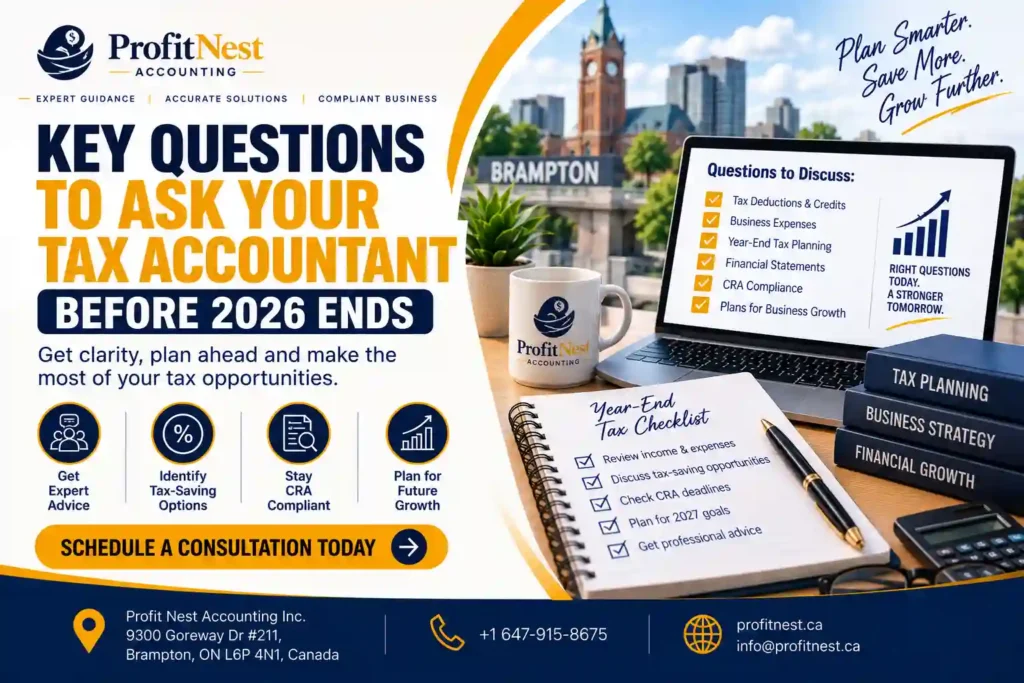
December 31 feels like a formality until it isn’t. For Brampton business owners, the weeks before year-end are actually the last real window to catch a missed deduction, fix a payroll gap, or make a purchase decision that changes what you owe — not after you file, but before the year even closes. Once January hits, most of those options are off the table.
This guide walks through what to review with your tax accountant before 2026 ends, organized around the ten questions worth asking, what documents to bring to that conversation, and the mistakes that tend to cost Brampton businesses the most. One note up front: not every business runs on a December 31 fiscal year-end, so “before year-end” means your corporation’s year-end, which may fall at a different point in the calendar.
What Should You Ask Your Tax Accountant Before the End of 2026?
Before the end of 2026, ask your tax accountant about eligible business deductions, corporate tax changes, GST/HST obligations, payroll records, financial statements, and upcoming CRA deadlines. Brampton business owners should also review their taxable income, year-end accounting records, and potential tax planning opportunities for 2027. Early preparation can help identify issues and support accurate tax filing.
Why Should Brampton Business Owners Consult a Tax Accountant Before 2026 Ends?
Understanding Your Current Tax Position
You can’t plan around a number you don’t know. A year-end check-in gives you a realistic read on where your taxable income stands, while there’s still time to act on it.
Identifying Potential Tax Deductions and Credits
Some deductions and credits depend on timing — a purchase made before versus after your year-end can land in a different tax year entirely. Reviewing this ahead of time keeps those options open.
Preparing for Upcoming CRA Obligations
Corporate filing deadlines, instalment payments, and GST/HST remittances don’t pause for the holidays. Knowing what’s coming in the first few months of 2027 means nothing catches you off guard.
10 Important Questions to Ask Your Tax Accountant Before the End of 2026
1. Have I Claimed All Eligible Business Tax Deductions?
This is the question that pays for the meeting. Business owners routinely miss deductions for home office use, vehicle expenses, professional fees, and small recurring costs that add up over a year. Walking through your expense categories with an accountant before year-end — rather than during tax season — gives you time to pull together missing receipts or documentation instead of scrambling in March.
2. How Could Ontario's 2026 Corporate Tax Changes Affect My Business?
Ontario reduced its small-business corporate tax rate as part of the 2026 Budget, and because the change took effect partway through the year, many corporations will see a blended rate rather than a flat number for 2026. Whether and how much this affects you depends on your taxable income, eligibility, and fiscal year-end, so it’s worth a direct conversation rather than assuming the headline rate applies to you.
3. Should I Review My Salary or Dividend Strategy Before Year-End?
How you pay yourself from your corporation affects your personal and corporate tax position differently, and some of that planning only works if it’s done before the year closes. A year-end review is the right time to confirm your current approach still makes sense.
4. Are My GST/HST Filings and Payments Up to Date?
Late or inconsistent GST/HST filings can quietly accumulate interest and penalties. Confirming your filing frequency, your remittances, and any outstanding balances before year-end avoids starting 2027 with a cleanup project.
5. What Financial Documents Should I Prepare for Tax Filing?
Ask specifically what your accountant needs from you, and when. The sooner you know, the less last-minute document-chasing you’ll do once filing season actually opens.
6. Are There Any Tax Credits or Incentives My Business May Qualify For?
Depending on your industry and activities, there may be credits worth exploring, from hiring incentives to sector-specific programs. These are easy to miss without someone actively checking your eligibility each year.
7. Should I Make Business Purchases Before My Fiscal Year-End?
If you’ve been planning equipment, software, or other capital purchases, the timing relative to your fiscal year-end can affect which tax year the deduction falls into. This is worth confirming before you buy, not after.
8. Are My Payroll Records and CRA Remittances Accurate?
Payroll errors tend to surface at the worst possible time — during a CRA review. A year-end check of your remittances, T4 preparation, and payroll records catches discrepancies while there’s still time to correct them.
9. What Tax Filing and Payment Deadlines Should I Prepare For in 2027?
Corporate tax returns are generally due six months after your fiscal year-end, though any balance owing is typically due two months after year-end (three months for certain qualifying small CCPCs). GST/HST and payroll remittance deadlines follow their own schedules depending on your filing frequency. Ask your accountant to map out your specific 2027 deadlines rather than relying on general rules of thumb.
10. What Tax Planning Strategies Should I Consider for 2027?
Year-end planning shouldn’t only look backward. Ask what’s worth setting up now, from income splitting considerations to how upcoming changes like the 2027 adjustment to Ontario’s small-business dividend tax credit might affect your plans.
How Can a Tax Accountant in Brampton Help You Prepare for 2027?
Staying ahead of CRA deadlines and requirements reduces the chance of interest, penalties, or an unwelcome surprise down the line.
ProfitNest is a Brampton-based accounting firm serving individuals and businesses across Toronto, Mississauga, Hamilton, and Ottawa. The team works through exactly this kind of year-end review with clients each year, connecting bookkeeping, financial statements, corporate and personal tax filing, payroll, and GST/HST so nothing falls through the cracks between services. If you’re newly incorporated, ProfitNest’s startup and incorporation support can also help make sure your structure is set up well before your first year-end arrives.
Frequently Asked Questions About Year-End Tax Planning
When should I meet my tax accountant before year-end?
What should I ask my accountant about 2026 taxes?
Can a tax accountant help reduce my business tax liability legally?
What tax documents should small businesses prepare?
Is December 31 the tax year-end for every Canadian corporation?
How can I prepare for the 2027 tax season?
Prepare for 2027 With Professional Tax Accounting Services in Brampton
Year-end planning isn’t about scrambling to find last-minute savings — it’s about knowing where you stand while there’s still time to do something about it. A short conversation before your fiscal year closes can catch missed deductions, confirm your filings are current, and set you up for a far smoother start to 2027.
Contact ProfitNest Accounting Inc. today for year-end tax planning support tailored to your business.