
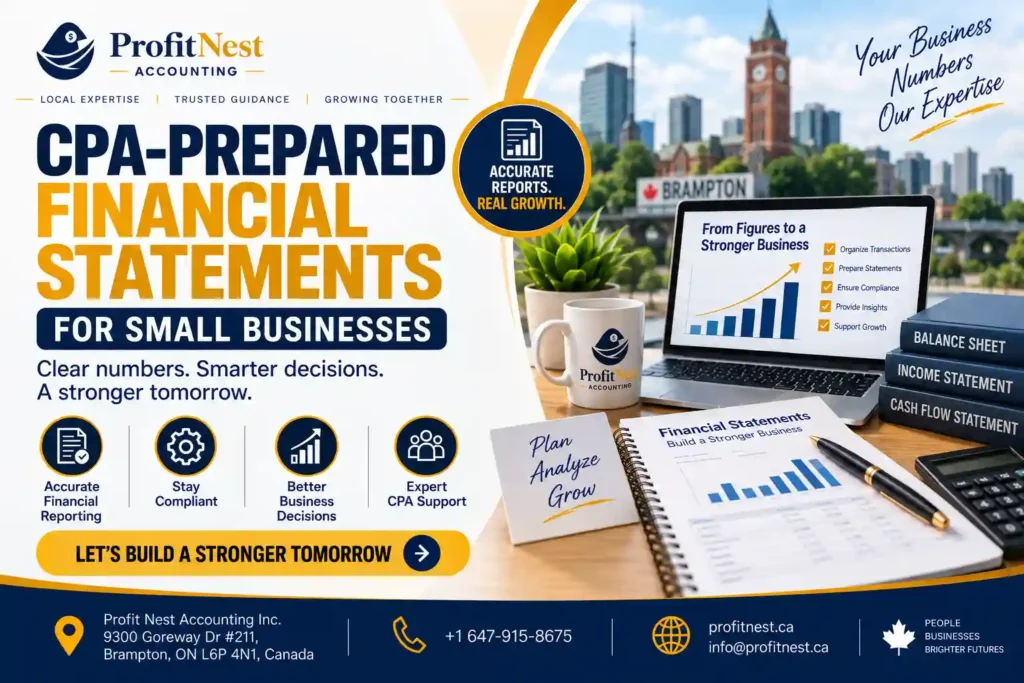
If you’ve ever stared at a stack of bank statements, invoices, and receipts wondering how any of it turns into an actual financial statement, you’re not alone. Most small business owners in Ontario know they need financial statements — for taxes, for loans, for simply understanding whether the business made money — but few know what actually happens between “messy records” and “finished report.”
That process is exactly what a CPA (Chartered Professional Accountant) is trained and licensed to handle. This guide walks through what financial statements actually are, what a CPA does step-by-step to prepare them, and why getting this right matters a lot more than most business owners realize — especially once tax season, a loan application, or a CRA request lands on your desk.
Quick Answer: How Does a CPA Prepare Financial Statements for a Small Business?
A CPA prepares financial statements by reviewing bookkeeping records, reconciling bank accounts, checking revenue and expenses, following up on receivables and payables, making necessary accounting adjustments, and then compiling the income statement, balance sheet, and cash flow statement. These reports give business owners a clear, accurate picture of financial performance and support tax filing, budgeting, and financing decisions.
What is a CPA, exactly? A CPA is a licensed, regulated professional under CPA Ontario, legally authorized to prepare notarized financial statements and represent clients before the CRA — a level of accountability that unlicensed bookkeepers or seasonal tax preparers simply don’t carry. That distinction matters more than most business owners realize until they’re the ones applying for a loan or facing a CRA review.
What Are Financial Statements for a Small Business?
Understanding Business Financial Records
Financial statements are the formal reports that summarize everything happening in your business financially — what came in, what went out, what you own, and what you owe. They’re built from your day-to-day records: sales invoices, expense receipts, payroll, bank transactions, and your general ledger.
Why Accurate Financial Statements Matter
Inaccurate or incomplete financial statements don’t just make bookkeeping messier — they can lead to overpaid or underpaid taxes, rejected loan applications, and decisions made on numbers that don’t reflect reality. Accuracy here isn’t a formality; it’s the foundation everything else is built on.
Who Needs Financial Statements?
Any business that files corporate taxes, applies for financing, brings on investors, or simply wants to understand its own performance needs financial statements. That includes sole proprietors scaling up, incorporated businesses, and anyone preparing for year-end accounting or a corporate tax filing deadline.
What Financial Statements Does a CPA Prepare?
Income Statement (Profit and Loss Statement)
This report shows revenue earned, expenses incurred, and the resulting net profit or loss over a specific period. It’s usually the first thing business owners want to see — did we actually make money this quarter or this year?
Balance Sheet
The balance sheet is a snapshot of what your business owns (assets), what it owes (liabilities), and what’s left over for the owner (equity) at a specific point in time. It’s the report lenders and investors tend to scrutinize most closely.
Cash Flow Statement
Profit on paper and cash in the bank aren’t always the same thing. The cash flow statement tracks how money actually moves in and out of the business — operations, financing, and investing activities — which is often where the real financial picture gets clearer.
Statement of Changes in Equity
Where relevant, this statement shows how owner contributions, withdrawals, and retained profits have changed the business’s equity position over the period.
How a CPA Prepares Financial Statements for Small Businesses in Ontario
This is the part most business owners never see — here’s what actually happens behind the scenes.
Step 1 – Review Bookkeeping and Accounting Records
The process starts with a full review of existing bookkeeping records: the general ledger, transaction history, and supporting documentation. This is where gaps, missing entries, or inconsistencies first get flagged.
Step 2 – Reconcile Bank Accounts and Transactions
Every bank and credit card account gets reconciled against recorded transactions to confirm the books match reality — no missing deposits, no unexplained charges, no duplicated entries.
Step 3 – Check Revenue and Business Expenses
Revenue is verified against sales records and invoices, while expenses are reviewed for accuracy and proper categorization. This step catches things like personal expenses mixed into business accounts or revenue that was recorded twice.
Step 4 – Review Accounts Receivable and Accounts Payable
Outstanding invoices owed to the business and bills the business still owes are reviewed to make sure nothing’s outdated, written off incorrectly, or missing entirely.
Step 5 – Make Necessary Accounting Adjustments
Adjusting entries — things like depreciation, accrued expenses, or prepaid items — are applied so the statements reflect the true financial position, not just the raw transaction history.
Step 6 – Prepare the Financial Statements
With clean, reconciled, and adjusted data, the CPA compiles the actual reports: income statement, balance sheet, cash flow statement, and statement of changes in equity where applicable.
Step 7 – Review and Explain the Financial Reports
A good CPA doesn’t just hand over a PDF — they walk through what the numbers mean, flag anything that needs attention, and connect the reports to next steps like corporate tax filing or budgeting decisions.
Why Do Small Businesses in Ontario Need Financial Statement Preparation?
Helps Business Owners Understand Profitability
It’s hard to make good decisions when you don’t actually know if you’re profitable. Financial statements turn a gut feeling into a clear answer.
Supports Business Budgeting and Planning
Accurate historical reports are the starting point for realistic budgets and forecasts — without them, planning is really just guessing.
Helps Prepare for Corporate Tax Filing
Clean financial statements make corporate tax filing faster, more accurate, and far less stressful, since the numbers going into your T2 return are already verified.
Improves Financial Record Organization
The preparation process itself often uncovers and fixes disorganized records, which pays off well beyond just the current reporting period.
Supports Business Loans and Financing Applications
Banks and lenders almost always require formal financial statements before approving financing — having them ready (and accurate) speeds up the entire process.
What Documents Does a CPA Need to Prepare Financial Statements?
Here’s a practical checklist to have ready before your appointment:
- Bank statements
- Sales invoices and revenue records
- Expense receipts
- Payroll records
- Accounts receivable and payable records
- Loan and credit statements
- Previous financial statements
- Bookkeeping reports
- Business asset records
Financial Statement Preparation vs Bookkeeping: What Is the Difference?
What Is Bookkeeping?
Bookkeeping is the ongoing, day-to-day process of recording transactions — sales, expenses, payments — as they happen. It’s the raw data collection.
What Is Financial Statement Preparation?
Financial statement preparation takes that raw bookkeeping data and turns it into formal, structured reports that summarize financial performance and position over a period.
Why Both Services Matter for Small Businesses
You can’t prepare accurate financial statements without solid bookkeeping behind them, and bookkeeping alone doesn’t give you the summarized reports lenders, investors, and the CRA actually want to see. That’s why most Ontario small businesses benefit from having both handled together rather than piecemeal.
How a CPA in Brampton Can Help With Financial Statement Preparation
Professional Accounting and Financial Reporting
A CPA brings the training, licensing, and accountability to prepare statements that hold up under scrutiny — whether that’s a lender, an investor, or the CRA.
Support for Small Business Owners
Beyond the reports themselves, a CPA translates the numbers into plain language, so business owners actually understand what they’re looking at and why it matters.
Year-End Accounting and Tax Preparation Support
Financial statement preparation typically ties directly into year-end accounting and corporate tax filing, making the transition from books to tax return far smoother.
Personalized Accounting Services in Brampton, Ontario
ProfitNest is a Brampton-based accounting firm working with individuals and businesses across Toronto, Mississauga, Hamilton, and Ottawa. The team handles bookkeeping, financial statement preparation, corporate tax filing, payroll, and GST/HST compliance — so your books and your tax filings are always working from the same accurate numbers, rather than being handled by two disconnected providers. For businesses just getting off the ground, ProfitNest also offers startup and incorporation support to make sure the financial foundation is set up correctly from day one.
Get Professional Financial Statement Preparation Services in Brampton
Accurate financial statements aren’t just a compliance checkbox — they’re the numbers you’ll actually rely on to understand your business, plan ahead, and stay ready for tax season, financing applications, or a CRA request. Getting them right takes more than a template; it takes someone who understands both the bookkeeping behind them and what they mean for your business.
Contact ProfitNest Accounting Inc. today to discuss your year-end accounting requirements and get the support your Brampton business needs.