
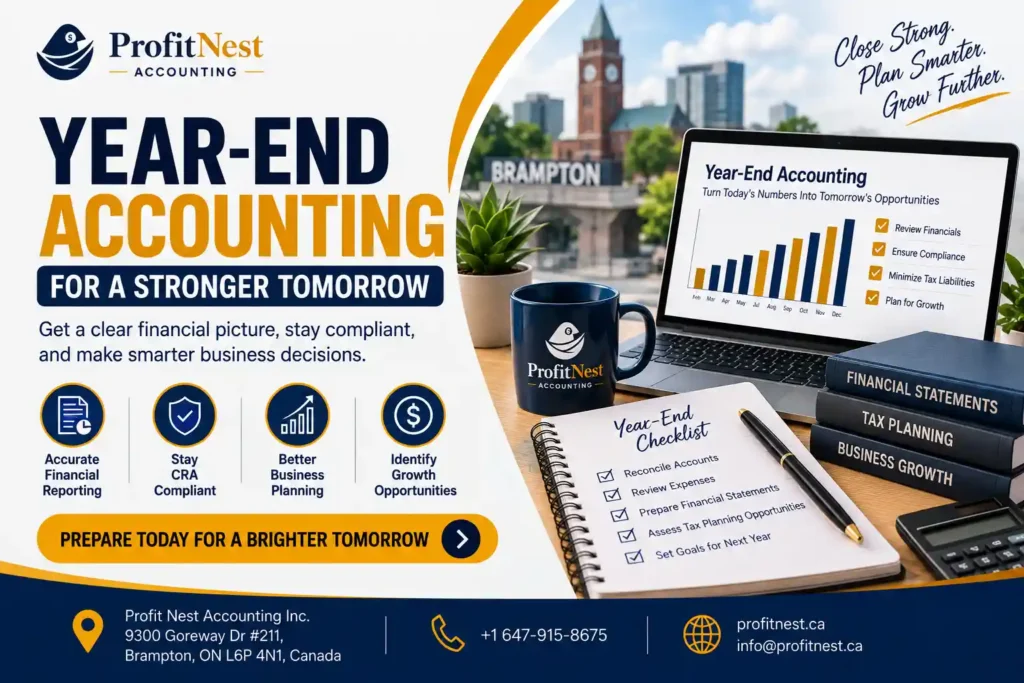
Every business in Ontario hits the same wall once a year: the fiscal year closes, and suddenly twelve months of receipts, invoices, bank statements, and half-remembered expenses need to turn into something the CRA will accept. That process has a name — year-end accounting — and how well you handle it determines whether tax season is a routine filing or a three-week scramble.
If you run a business in Brampton, Mississauga, or anywhere across the GTA, this guide walks you through what year-end accounting actually involves, why it matters more than most owners realize, and when it makes sense to bring in a CPA rather than muddling through alone.
What Is Year-End Accounting?
Year-end accounting is the process of reviewing, correcting, and finalizing all of your business financial records at the close of your fiscal year. It’s the point where day-to-day bookkeeping gets checked, reconciled, and converted into formal year-end financial statements — an income statement, a balance sheet, and a cash flow statement — that accurately represent how your business actually performed.
Think of bookkeeping as recording the game as it happens, and year-end accounting as reviewing the tape afterward to make sure the score is right. Transactions get verified, accounts get reconciled, accounting adjustments get made, and only then are the numbers reliable enough to base your corporate tax filing on.
Quick definition: A CPA (Chartered Professional Accountant) is a licensed, regulated professional under CPA Ontario, legally authorized to prepare notarized financial statements and represent clients before the CRA — unlike unlicensed bookkeepers or seasonal tax preparers.
That distinction matters more than most business owners expect, and we’ll come back to it.
Why Is Year-End Accounting Important for Brampton Businesses?
Helps Prepare Accurate Financial Statements
Financial statement preparation is the core output of the year-end accounting process. Without a proper review, your statements reflect whatever your bookkeeping software happened to categorize — including the misclassified expenses, the duplicate entries, and the transactions nobody got around to coding. Accurate statements are what lenders, investors, and the CRA actually rely on.
Supports Corporate Tax Filing
Your T2 corporate return is built directly on your year-end numbers. If those numbers are off, your tax filing is off — which means either overpaying tax you didn’t owe or underreporting and inviting a CRA review. Clean year-end work makes corporate tax preparation straightforward instead of stressful.
Helps Identify Business Expenses and Adjustments
This is where real money surfaces. A proper year-end review catches deductible expenses that were never claimed, depreciation that wasn’t recorded, prepaid amounts sitting in the wrong period, and accruals that were missed entirely. Many small business owners discover thousands in legitimate deductions they’d have otherwise walked past.
Improves Financial Decision-Making
Once your books are finalized, you can finally see the business clearly — which services are actually profitable, where costs crept up, how your cash flow behaved through the year. Small business financial reporting isn’t just a compliance exercise; it’s the data you use to plan the next twelve months.
Helps Maintain Organized Accounting Records
Businesses that close their books properly each year build a clean historical record. That pays off when you apply for financing, bring on a partner, sell the business, or receive a CRA inquiry. Businesses that don’t end up reconstructing years of records under time pressure.
What Does the Year-End Accounting Process Include?
Reviewing Bookkeeping Records
Everything starts with the books. Transactions are reviewed for accuracy, correct categorization, and completeness — catching anything that was coded to the wrong account or missed entirely during the year.
Reconciling Bank and Business Accounts
Bank reconciliation confirms that what your records say matches what your bank, credit card, and loan statements say. Discrepancies here are common and almost always signal something that needs fixing before the statements are finalized.
Reviewing Income and Expenses
Revenue and expense accounts are examined line by line to confirm amounts landed in the correct fiscal period and that nothing personal slipped into business expenses (or the reverse — business costs sitting unclaimed on a personal card).
Preparing Financial Statements
With the underlying data verified, your income statement, balance sheet, and cash flow statement get prepared. These three together give a complete picture: profitability, financial position, and actual cash movement.
Identifying Accounting Adjustments
Adjusting entries handle depreciation, accrued expenses, prepaid items, inventory corrections, and any reclassifications the review turned up. This is the step that separates a genuine year-end close from simply printing a report out of accounting software.
Preparing for Corporate Tax Filing
Finally, the finalized statements are used to prepare your corporate return, with attention to available deductions, credits, and tax planning opportunities that reduce what you owe — legitimately and within CRA rules.
Why Hire a CPA for Year-End Accounting in Brampton?
Professional Financial Reporting
A CPA prepares financial statements to professional standards that banks, lenders, and the CRA recognize. If you ever need financing or face a review, statements prepared by a licensed professional carry weight that a spreadsheet simply doesn’t.
Tax and Accounting Support
The advantage of working with a firm offering both accounting and tax services is that the person preparing your statements is also thinking about your tax position. Year-end review and tax planning happen together rather than as disconnected handoffs.
Better Business Financial Organization
A CPA doesn’t just close your books once — a good one fixes the process that made year-end messy in the first place, so next year takes a fraction of the effort. That often means tightening up ongoing bookkeeping rather than only cleaning up after the fact.
Support for Small Business Owners
Most small business owners in Brampton aren’t accountants, and they shouldn’t have to be. Having a professional accountant in Brampton handle year-end frees you to run the business while someone qualified handles CRA compliance, deadlines, and the details.
This is the model ProfitNest is built around — a Brampton-based team handling bookkeeping, corporate tax filing, personal tax filing, payroll, and GST/HST compliance for businesses across Brampton, Mississauga, Toronto, Hamilton, and Ottawa, so year-end isn’t a separate emergency every spring.
Year-End Accounting Checklist for Brampton Business Owners
Review Your Bookkeeping
Go through the year’s transactions and flag anything uncategorized, duplicated, or unclear. The more you clean up before handing off, the faster and cheaper the professional review goes.
Gather Business Financial Documents
Pull together bank and credit card statements, sales invoices, expense receipts, loan documents, payroll records, and any asset purchase paperwork from the year.
Check Outstanding Payments and Receivables
Review accounts receivable for invoices customers still owe you, and accounts payable for bills you haven’t paid. Both affect your year-end position and need to be accurate.
Review Business Expenses
Look for deductible costs that never made it into the books — home office, vehicle and mileage, subscriptions, professional fees, equipment. These are the most commonly missed deductions among small businesses.
Contact Your CPA or Accountant
Reach out well before your fiscal year-end rather than after. Early conversations create room for tax planning decisions that are no longer available once the year has closed.
Get Professional Year-End Accounting Support in Brampton
Year-end accounting isn’t just a box to tick before tax season — it’s the annual reset that keeps your business financial records accurate, your CRA compliance solid, and your decisions grounded in real numbers instead of guesswork.
Keeping your records accurate and organized is an important part of that process. At ProfitNest Accounting Inc., we provide professional accounting and tax services to help businesses manage their financial reporting, bookkeeping, and tax preparation needs — with straightforward advice and a team that actually picks up the phone.
Talk to a ProfitNest Tax Expert →
Contact ProfitNest Accounting Inc. today to discuss your year-end accounting requirements and get the support your business needs.