
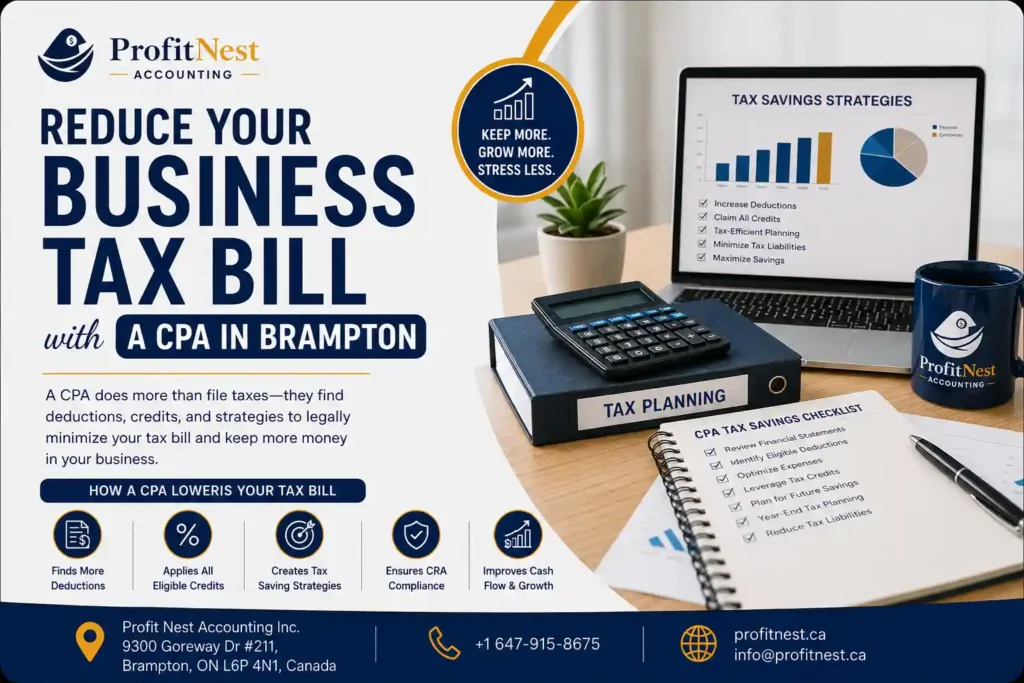
Yes — a CPA reduces your business tax bill by legally applying every deduction, credit, and structure your business qualifies for, and by planning for it before the year ends, not after.
I want to be upfront about this from the start. A CPA doesn’t lower your taxes through loopholes or grey-area tricks. We lower your taxes by knowing the Income Tax Act well enough to apply it fully in your favour — nothing more, nothing less.
Most business owners in Brampton I talk to only think about taxes in March or April. By then, the tax year is closed. The expenses are what they are. The business structure is locked in. There’s very little left to plan. That’s the core problem I see over and over, and it’s the first thing I try to fix with a new client.
Tax Reduction vs. Tax Avoidance: What's the Difference?
Tax reduction is using the rules as written. Tax avoidance (in the aggressive, illegal sense) is bending or hiding facts to get around them.
- Tax reduction (legal): Claiming a home office deduction because you genuinely work from home, using Capital Cost Allowance on equipment you actually bought and use, or timing a purchase to fall in the right fiscal year.
- Tax evasion (illegal): Hiding cash income, inventing expenses that never happened, or misclassifying personal costs as business costs.
A CPA works entirely in the first category. My job is to find every legitimate opportunity your business already qualifies for — not to manufacture ones that don’t exist.
Why Tax Planning Should Start Before Tax Season
Tax planning works best when it happens throughout the fiscal year, because most tax-saving decisions require action before your year-end, not after it. Once your fiscal year closes, your options shrink fast. You can’t retroactively buy equipment to claim CCA. You can’t reclassify how you paid yourself in July. You can’t go back and register for a program you missed the deadline for. That’s why I tell business owners: the return we file in tax season is really just the report card. The grade was decided months earlier.
Results always depend on your specific situation — your business structure, income level, expense mix, industry, and how organized your records are. There’s no single number that applies to every business, and any CPA who promises one without reviewing your books first isn’t being straight with you.
10 Ways a CPA Can Help Reduce Your Business Taxes
Here are the specific levers I use with clients. Each one is a small, standalone opportunity — some will apply to your business, some won’t, and that’s exactly why a review matters.
1. Identify Every Eligible Business Tax Deduction
A deduction is a business expense the CRA allows you to subtract from your income before tax is calculated — and most business owners miss several every year.
Common categories I check first:
- Office expenses — supplies, rent, a portion of home-office costs
- Professional fees — legal, accounting, consulting
- Advertising — online ads, print, signage, website costs
- Business insurance — liability, property, professional coverage
- Vehicle expenses — mileage, fuel, maintenance for business use
- Travel expenses — client meetings, conferences, work-related trips
- Software and technology — subscriptions, cloud tools, hardware
- Employee-related expenses — wages, benefits, training
Each of these needs proper documentation. A missed receipt is a missed deduction — I cover this more in the record-keeping section below.
2. Maximize Available Business Tax Credits
A tax credit reduces your tax bill directly, dollar for dollar, which makes it more valuable than a deduction of the same size.
Part of my review process is checking whether your business qualifies for federal or provincial credits tied to your industry, hiring activity, or investments. Eligibility depends on your sector and activities, so this is never a blanket answer — it’s a case-by-case review of your specific business.
3. Choose the Right Business Structure
Your business structure — sole proprietorship, partnership, or corporation — directly changes how much tax you pay and when you pay it.
- Sole proprietorship: Simple to run, but business income is taxed at your personal rate, which can climb quickly as revenue grows.
- Partnership: Similar personal-rate taxation, split between partners based on the partnership agreement.
- Corporation: Can offer lower initial tax rates on active business income and more flexibility in how and when you draw money out.
I walk new and growing businesses through this because the “right” structure at $40,000 in revenue often isn’t the right one at $150,000. If incorporation is on your mind, our Startup & Incorporation Support team and Company Registration service are built for exactly this transition point.
4. Plan Business Expenses Strategically
Timing matters — the same expense can help you more in one fiscal year than another, depending on your income level and cash flow.
I look at whether it makes sense to accelerate a purchase into the current year or push it into the next one, and I make sure every expense has the documentation to back it up if the CRA ever asks.
5. Use Capital Cost Allowance Effectively
Capital Cost Allowance (CCA) lets you deduct the cost of business assets — like equipment or vehicles — gradually over time instead of all at once.
In plain terms: if you buy a $20,000 piece of equipment, you usually can’t write off the full $20,000 in year one. CCA spreads that deduction across several years based on CRA-set rates for that asset class. Used well, it smooths out your taxable income and avoids a big spike in what you owe in any single year.
6. Plan Payroll and Owner Compensation
How you pay yourself — salary, dividends, or a mix — changes your personal and corporate tax outcome.
At a high level: salary creates RRSP room and CPP contributions but is taxed as employment income; dividends are taxed differently and don’t create RRSP room. The right mix depends on your retirement plans, cash flow needs, and corporate structure. Our Payroll Services team handles the remittances and filings once we’ve mapped out the right approach for you.
7. Keep Business and Personal Expenses Separate
Mixing personal and business expenses is one of the fastest ways to lose deductions and invite CRA scrutiny.
Separate bank accounts and credit cards make your records clean, your deductions defensible, and your year-end review much faster. I’ve seen returns take twice as long to prepare simply because personal and business transactions were tangled together in one account.
8. Review GST/HST Obligations
Proper GST/HST tracking prevents costly filing errors, missed input tax credits, and penalties.
I regularly see businesses either over-remitting GST/HST because they didn’t claim eligible input tax credits, or under-remitting because they missed a registration threshold. Both cost money — one in overpayment, the other in penalties and interest. Our GST/HST Filing service covers registration, filing, and rebate applications so this stays on track.
9. Plan for Corporate Tax Before the Deadline
Corporations that estimate their tax position throughout the year avoid surprises at filing time and can plan instalment payments accordingly.
Waiting until the deadline to find out what you owe removes your ability to plan cash flow around it. I recommend a mid-year check-in for incorporated clients specifically so there are no surprises. Our Corporate Tax Filing service is built around this ongoing-review approach rather than a once-a-year drop-off.
10. Find Tax Planning Opportunities You May Have Missed
A full financial review often uncovers deductions, credits, or structural changes a business has been missing for years — not just the current one.
This is usually where I add the most value for an existing business. I look at the complete financial picture — prior filings, current structure, expense patterns — rather than just the current year’s numbers in isolation.
Common Tax Mistakes That Can Increase Your Business Tax Bill
The businesses paying more tax than they should almost always share one of these seven habits.
Missing Legitimate Tax Deductions
Expenses that qualify but never get claimed because they weren’t tracked or the owner didn’t know they were eligible.
Poor Record Keeping
Missing receipts, no expense log, no clear paper trail — all of which make deductions harder to defend and easier to lose.
Mixing Personal and Business Expenses
Covered above, and worth repeating — this single habit causes more lost deductions than almost anything else I see.
Waiting Until Tax Season to Plan
By the time your return is due, most of your planning options for that year are already gone.
Incorrect GST/HST Reporting
Wrong rates, missed input tax credits, or late registration — all of which lead to penalties or lost recoveries.
Choosing the Wrong Business Structure
Staying a sole proprietorship too long, or incorporating before it actually makes financial sense, both cost money in different ways.
Failing to Keep Supporting Documents
Even a legitimate deduction can be denied on review if you can’t produce the receipt or contract behind it.
How Much Can a CPA Save Your Business on Taxes?
There’s no fixed dollar amount — savings depend entirely on your revenue, structure, expenses, investments, payroll setup, available credits, and prior tax planning.
I won’t give you a made-up percentage or a “clients typically save $X” line, because it wouldn’t be honest. A business with clean books, a smart structure, and a few missed credits might save meaningfully. A business that’s already well-optimized might see smaller gains from a review, but stronger ongoing protection against future mistakes. Factors that genuinely move the number:
- Revenue and profit level
- Business structure (sole prop vs. corporation)
- Total deductible expenses
- Capital investments made during the year
- Payroll and owner compensation setup
- Credits your industry qualifies for
- How much tax planning was done in prior years
The honest answer is: we won’t know your number until we look at your actual numbers.
When Should a Brampton Business Hire a CPA for Tax Planning?
The best time is before a major change happens in your business — not after.
You're Starting a New Business
Getting your structure and bookkeeping right from day one avoids costly corrections later.
Your Business Revenue Is Growing
Growth changes your tax bracket, your GST/HST obligations, and often the case for incorporation.
You're Hiring Employees
Payroll brings CRA remittance deadlines, T4 filings, and compliance requirements that are easy to get wrong without support.
You're Incorporating
Incorporation timing and setup decisions affect your tax position for years afterward.
You're Buying Business Equipment or Property
Larger purchases interact directly with CCA planning and cash flow timing.
You're Paying More Tax Than Expected
This is usually a sign that deductions, credits, or structure weren’t optimized in a prior year.
Your Business Has Complex Tax Obligations
Multiple revenue streams, cross-province sales, or multi-year filing gaps all call for a dedicated review.
CPA Tax Planning Checklist for Brampton Business Owners
Use this list as a starting point for your own year-round tax review — even before you talk to a CPA.
- Review your business structure
- Review deductible expenses
- Check available tax credits
- Review GST/HST filing status
- Review payroll and owner compensation
- Review Capital Cost Allowance claims
- Organize receipts and supporting documents
- Review previous tax returns for missed opportunities
- Estimate your upcoming tax liability
- Build a tax-planning strategy for the year ahead
CPA vs. DIY Tax Software: Which Is Better for Your Business?
DIY software works for simple, straightforward returns. A CPA is better once your business has any real complexity — payroll, multiple expense categories, or growth decisions to make.
Factor | CPA | DIY Tax Software |
Planning | Personalized tax planning | Mostly self-directed |
Advice | Business-specific advice | Limited guidance |
Complexity | Reviews complex situations | Better for simpler returns |
Opportunities | Helps identify planning opportunities | Depends entirely on user input |
Support | Ongoing professional support | Primarily software-based |
If your business is a single income stream with minimal expenses, software can work fine. Once you’re managing payroll, GST/HST, multiple deduction categories, or thinking about incorporation, the gap between the two options grows quickly.
Why Local Businesses in Brampton Work With a CPA
Local businesses choose a CPA who understands Canadian tax rules and the specific patterns of running a business in Brampton and the GTA.
I won’t claim to be “the best” without evidence, but here’s what I can say plainly: working with a CPA means someone is tracking your Canadian tax requirements year-round, giving business-specific planning advice, understanding the local business landscape, and staying available for ongoing accounting support — not just a single filing in April. That combination of tax filing, compliance, and long-term financial planning is what separates a CPA relationship from a once-a-year transaction.
Frequently Asked Questions - Business Tax Planning in Brampton
Can a CPA legally reduce my business taxes?
How can a CPA help a small business save on taxes?
Can a bookkeeper represent me in a CRA audit?
What business expenses are tax deductible in Canada?
When should a business start tax planning?
Should I hire a CPA before incorporating?
Can a CPA help with GST/HST?
What is the difference between a CPA and a tax accountant?
What is the difference between a CPA and a tax accountant?
Can a CPA help me fix previous tax mistakes?
Final Thoughts: Don't Wait Until Tax Season to Plan
A CPA’s real value isn’t preparing your tax return — that’s just paperwork at the end of the process. The bigger opportunity is identifying legitimate tax-planning strategies throughout the year, so your business stays fully compliant while avoiding unnecessary tax costs.
If you’re a business owner in Brampton and you’ve been treating tax season as a once-a-year scramble, that’s the one habit worth changing first. Everything else in this guide follows from that single shift.
Looking for a CPA for your business in Brampton? Contact ProfitNest to discuss your business tax planning and accounting needs, or See Our Full Range of Services to find the right starting point for your business.